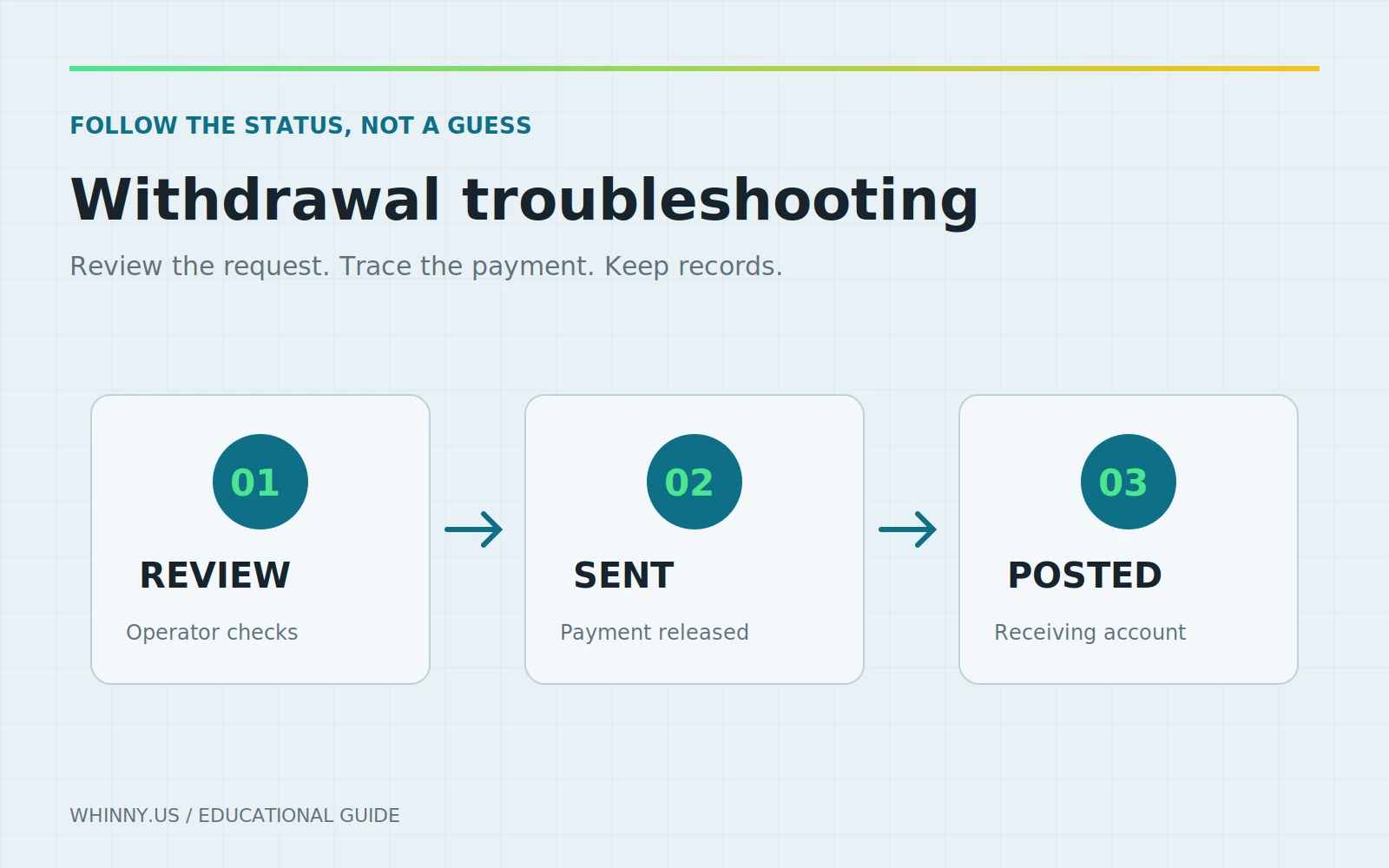
A delayed withdrawal leaves you with two questions: where is the money, and what should you do next? Start by separating the platform’s review from the payment’s journey. An approval message is not a bank deposit, and a “sent” notification is not proof that your receiving account has been credited.
This guide offers a practical checking and escalation process, not a promise about any operator. Labels, eligibility rules, payment methods, and complaint options differ. For the basic request process, see how to withdraw; for other transaction issues, visit payment problems.
1. Identify the stage, not just the status label
Use the following stages as questions to ask, rather than universal definitions. A platform might combine stages or use “completed” differently. PayPal, for example, explains that “Complete” means a transfer has been processed and sent out of PayPal; arrival still depends on factors including the transfer type and the bank’s procedures.[1]
| Stage | Working interpretation to confirm | Useful next question |
|---|---|---|
| Pending review | The request is recorded but review remains unresolved. | Is any action required from me, and where is that requirement displayed? |
| Approved | The operator has authorized the request, but dispatch is not established. | Has the payment actually been submitted to the payment provider? |
| Sent | The sender reports handing the payment onward. | What dispatch date, payment method, and traceable reference can you provide? |
| Bank posted | The receiving account shows the matching credit. | Does the amount match, and does the bank show it as available? |
A deduction from your platform balance alone does not answer those questions. Compare the withdrawal record with the receiving account’s transaction history. If the destination is a wallet rather than a bank, check that wallet first; any later wallet-to-bank transfer is a separate transaction to track.
2. Check the applicable timing without inventing a deadline
Find the withdrawal guidance inside the account or on the operator’s official help pages. Save the wording that applies to your method and location. Distinguish a review estimate from a transfer estimate, and check which event starts each: submission, approval, or dispatch.
Ask what the estimate actually covers
If guidance mentions business days, check its cutoff, timezone, and holiday treatment. PayPal’s own instructions identify timing differences by transfer method and note that cutoffs, weekends, or holidays can affect arrival.[1] Those instructions are a provider-specific example, not a timetable for every platform.
Record both the request timestamp and the latest status-change timestamp. If the stated window has passed, quote it in your support request. If no estimate exists, ask for the current stage, outstanding action, and next update checkpoint. “Still processing” is a status description, not an explanation of who currently needs to act.
3. Check account details without creating another problem
Review the destination shown in the original request, using its masked account or card identifier. Confirm the currency, amount, selected method, and any visible verification notice. PayPal identifies incorrect bank information and mismatched account details among possible reasons for withdrawal delays.[1] Ask your operator whether a similar issue applies rather than assuming it does.
If a document is requested, independently open the official site or app and look for the requirement there. Ask what is missing and how to use the verified secure upload process. Do not attach identity documents, full bank details, passwords, or verification codes to an ordinary support email.
Avoid canceling and resubmitting simply to see whether it helps. First ask whether cancellation is possible, what happens to the existing request, and whether it changes its place in review. Keep a record of the answer before making changes.
4. Build one clear evidence file
A useful record explains the problem without exposing your identity. Keep originals privately and make redacted copies for routine correspondence. The CFPB recommends including important dates, amounts, communications, and supporting documents when submitting a financial complaint.[5]
| Record | Useful detail | Privacy precaution |
|---|---|---|
| Withdrawal request | Reference, amount, currency, date, timezone, method. | Keep full destination numbers out of routine messages. |
| Status history | Dated screenshots and exact label changes. | Crop unrelated balances and personal details. |
| Applicable guidance | Page address, saved wording, and capture date. | Keep the original privately; share relevant excerpts. |
| Support history | Ticket number, replies, promised follow-up, requested action. | Do not publish private tickets or account identifiers. |
| Receiving account | Relevant transaction search or statement excerpt. | Use a verified secure channel if a statement is required. |
Separate observations from conclusions. “No matching credit appears in my bank history” is precise. “The bank lost the money” is a conclusion you may not be able to support. Keep dates and amounts consistent across every message.
5. Follow an evidence-led escalation timeline
This sequence is driven by events, not a fixed number of hours. You do not need to wait through it if you suspect account compromise or a fraudulent payment.
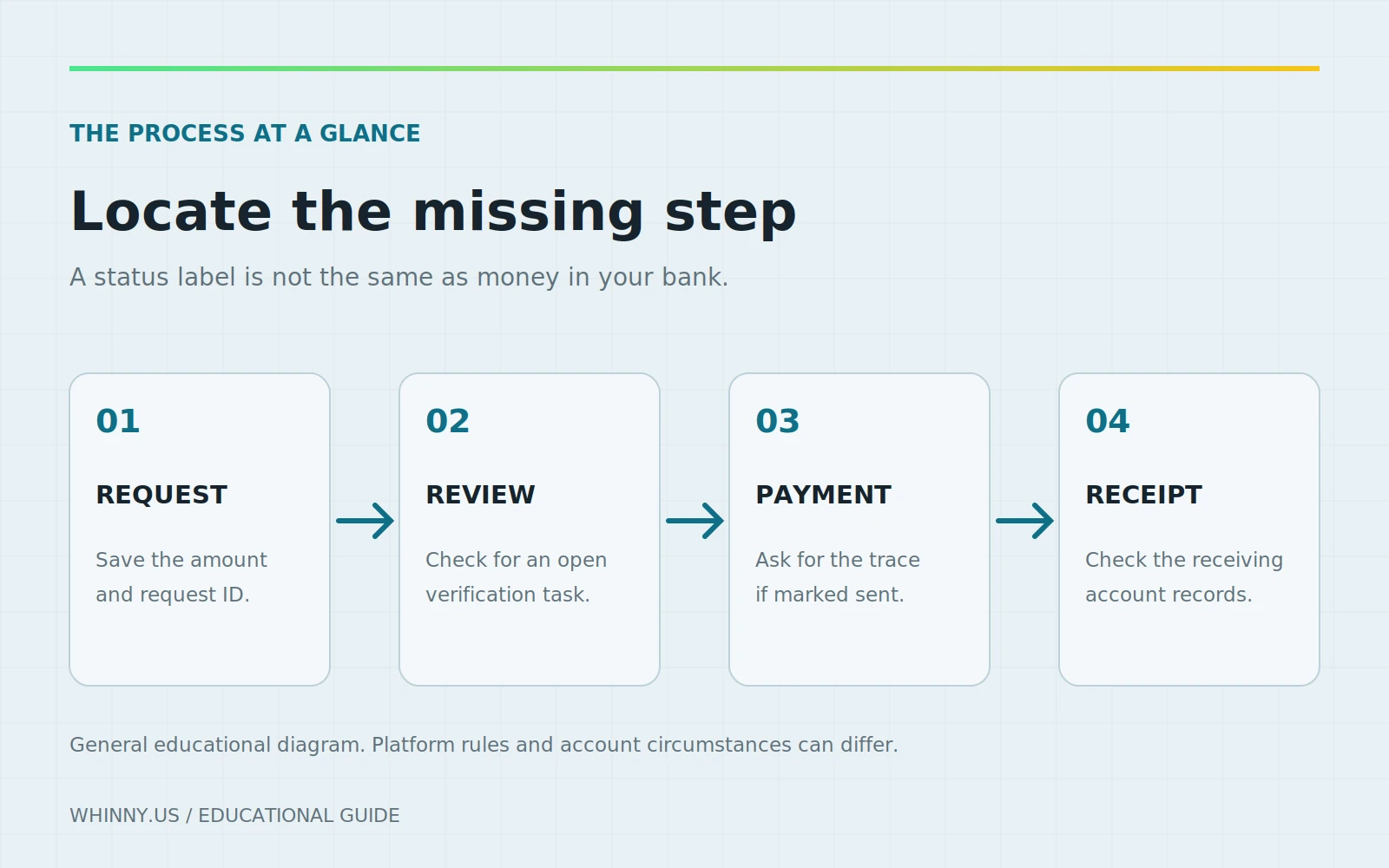
- Capture the present state. Save the withdrawal details, account notices, and receiving-account check before editing anything.
- Resolve a verified action request. Complete only the requirement you confirmed through the official account. Record submission and acknowledgment separately.
- Open one support case. Ask which stage applies, who holds the next action, and whether the published estimate still applies to this request.
- Follow up at the stated checkpoint. Reply on the same ticket with new facts. If the checkpoint passes without an answer, request a payments-team review or the formal complaint process.
- Trace a reportedly sent payment. Request the dispatch details and a reference usable by the receiving provider. Contact that provider through its official channel.
- Escalate the unresolved issue. Ask for a written explanation and an appropriate complaint route. Keep the original withdrawal and any later fraud concern clearly distinguished.
If support says “ask your bank,” request the information the bank will need. If the bank cannot locate the payment, record its response and return it to the sender. Do not treat an internal ticket number as proof that a bank transfer occurred.
6. Send a focused support message
Use the account’s support area or a contact address you independently verified. The FTC advises contacting a company through a website or phone number you know is real, not contact information supplied in a suspicious message.[4]
Subject: Withdrawal status clarification — [withdrawal reference]
Hello, I requested [amount and currency] on [date, time, timezone] using [payment method]. The current status is “[exact label],” last updated on [date]. I checked the receiving account and cannot find the matching credit.
Please confirm whether this request is awaiting review, approved but not dispatched, or sent. Is any action required from me? If sent, please provide the dispatch date and a payment reference the receiving provider can use. If still under review, please identify the outstanding requirement and next update checkpoint.
The published guidance I checked says “[relevant wording].” My existing ticket is [ticket number]. I can provide redacted screenshots through your verified secure channel. Thank you.
Remove any line you cannot substantiate. The placeholders are for transaction facts, not passwords, identity-document numbers, complete card numbers, or security codes.
7. Recognize fake help before paying again
Be suspicious when someone contacts you privately claiming they can “unlock” or recover your money for an upfront payment. The FTC describes recovery scams that disguise those payments as processing charges, administrative fees, retainers, or taxes.[2]
Warning signs include pressure to act immediately, a new personal wallet address, requests for remote device access, or instructions to keep the interaction secret. A familiar logo or knowledge of your withdrawal amount is not enough to establish that the person is legitimate.
Separate disclosed fees from an unsolicited recovery pitch
Do not assume that every fee is fraudulent: PayPal, for example, discloses fees for certain withdrawal methods.[1] The safe response to a new demand is independent verification against official terms and the authenticated account—not payment to the person making the demand.
If you already paid a suspected scammer, contact the bank or payment service used to send the money immediately and ask about reversal or recovery options; the FTC recommends acting through the relevant payment provider.[3] Recovery is not guaranteed. If you shared credentials, change affected passwords and enable two-factor authentication, as the FTC recommends.[3]
8. Escalate appropriately and protect your budget
For an unresolved U.S. bank or money-transfer service issue, review the CFPB complaint process: it accepts complaints about checking accounts, money transfers, virtual currency, and money services.[5] That does not establish jurisdiction over every gaming operator or withdrawal dispute. Identify the company and service involved before selecting a route.
For suspected fraud, the FTC provides reporting guidance and directs consumers to ReportFraud.ftc.gov.[3] Describe events accurately; do not label an authorized payment “unauthorized” simply because a withdrawal is delayed. Ask your provider about applicable dispute procedures and deadlines rather than relying on a generic online timetable.
Meanwhile, budget as though the money is unavailable. Do not commit it to rent or bills before confirming receipt and availability. Pause further spending, set a specific time to check the ticket, and consider a break or available account limits if the delay is pushing you to play more. A disputed balance is not a reason to risk additional money.
Frequently asked questions
Does “approved” mean the money has reached my bank?
No. Ask whether the payment was dispatched and check the receiving account. Treat approval and receipt as separate questions unless the provider explicitly explains otherwise.
Should I keep opening new tickets?
Prefer one documented thread and the formal escalation route. Add new evidence and request a specific next action rather than repeatedly sending the same message.
Can more play or another deposit fix the delay?
Do not use either as a troubleshooting step. Ask for a written explanation of any claimed restriction and pause spending while you investigate.