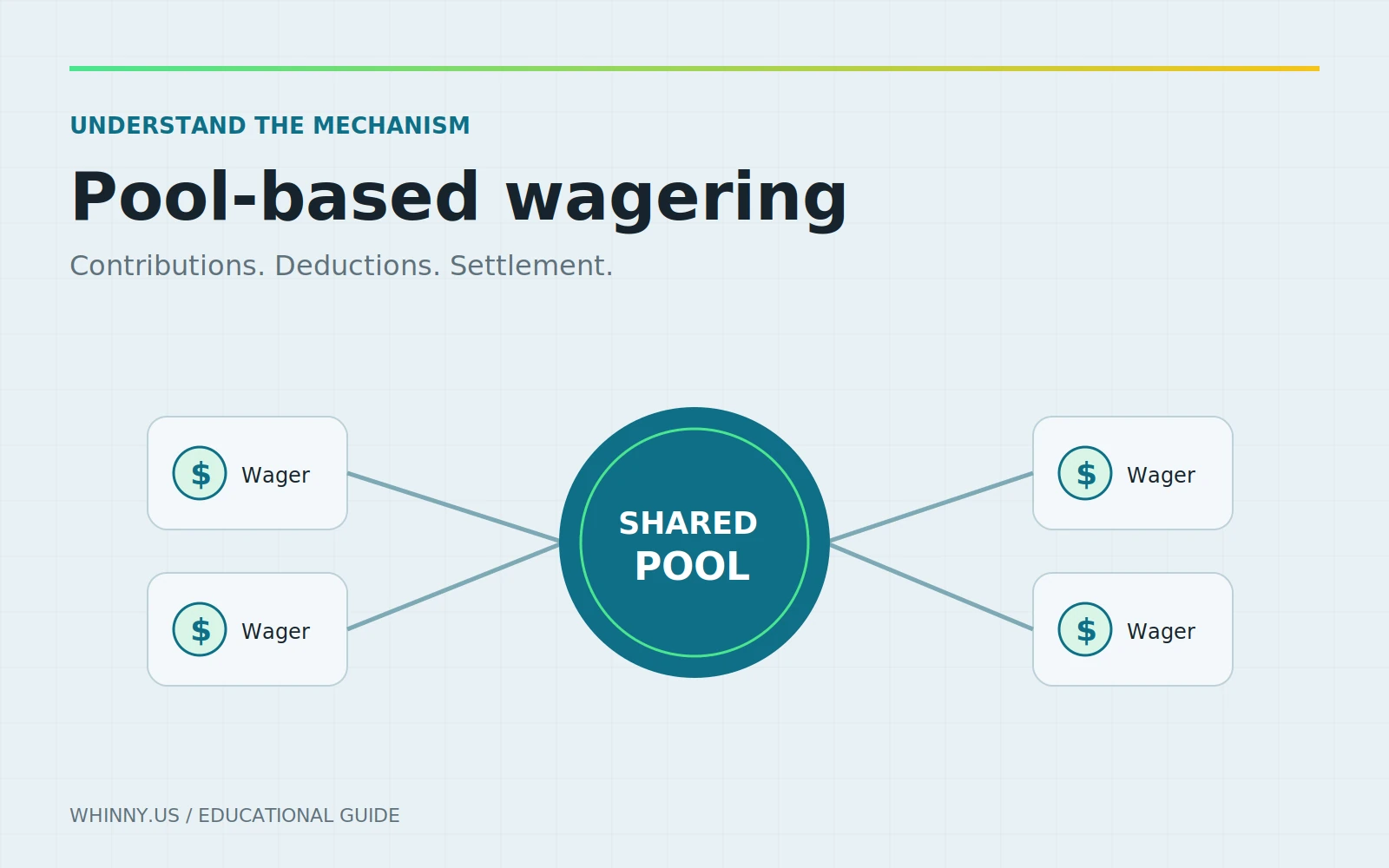
Pari-mutuel wagering is easier to understand when you separate three questions: what outcome qualifies, where the payout money comes from, and when the result becomes official. In a pool, the amount payable depends on the collected stakes and the winning interests, rather than simply on a price accepted earlier. NYRA explicitly distinguishes its final pool odds from the odds visible when a wager was placed.[2]
This guide explains that distinction and provides a method for reading results without mistaking an estimate for a settlement. It uses conventional horse-racing examples, not a description of Whinny.us account features or product rules. For a shorter introduction, see how pari-mutuel wagering works.
1. Pools versus fixed odds: what determines the return?
The central distinction is the basis of payment. The Gambling Commission’s definition describes pool betting by reference to aggregate stakes, division among winners, or other specified terms.[1] NYRA explains its horse-racing pools as wagering against others making the same type of wager in the same race, with a percentage deducted from the money wagered.[2]
For comparison, a conventional fixed-odds wager uses an agreed price, subject to its settlement terms; it does not ordinarily recalculate that price from the final distribution of a shared pool. NYRA highlights precisely this contrast when explaining why its pool payouts use final odds rather than the price displayed at acceptance.[2]
| Question | Pari-mutuel pool | Conventional fixed odds |
|---|---|---|
| What sets the return? | Pool distribution and applicable deductions.[2] | The accepted price and settlement terms.[2] |
| Is the earlier display decisive? | No: current odds can change before final calculation.[2] | The accepted odds, rather than a later pool calculation, are the starting point.[2] |
| What should you check? | Pool identity, official result, payout unit, and deductions. | Accepted price, qualifying outcome, and adjustment or void rules. |
The practical lesson is not that one format is safer. It is that their numbers answer different questions. A pool display describes a developing distribution; an accepted fixed price describes the terms of a particular wager.
2. Follow the money through the correct pool
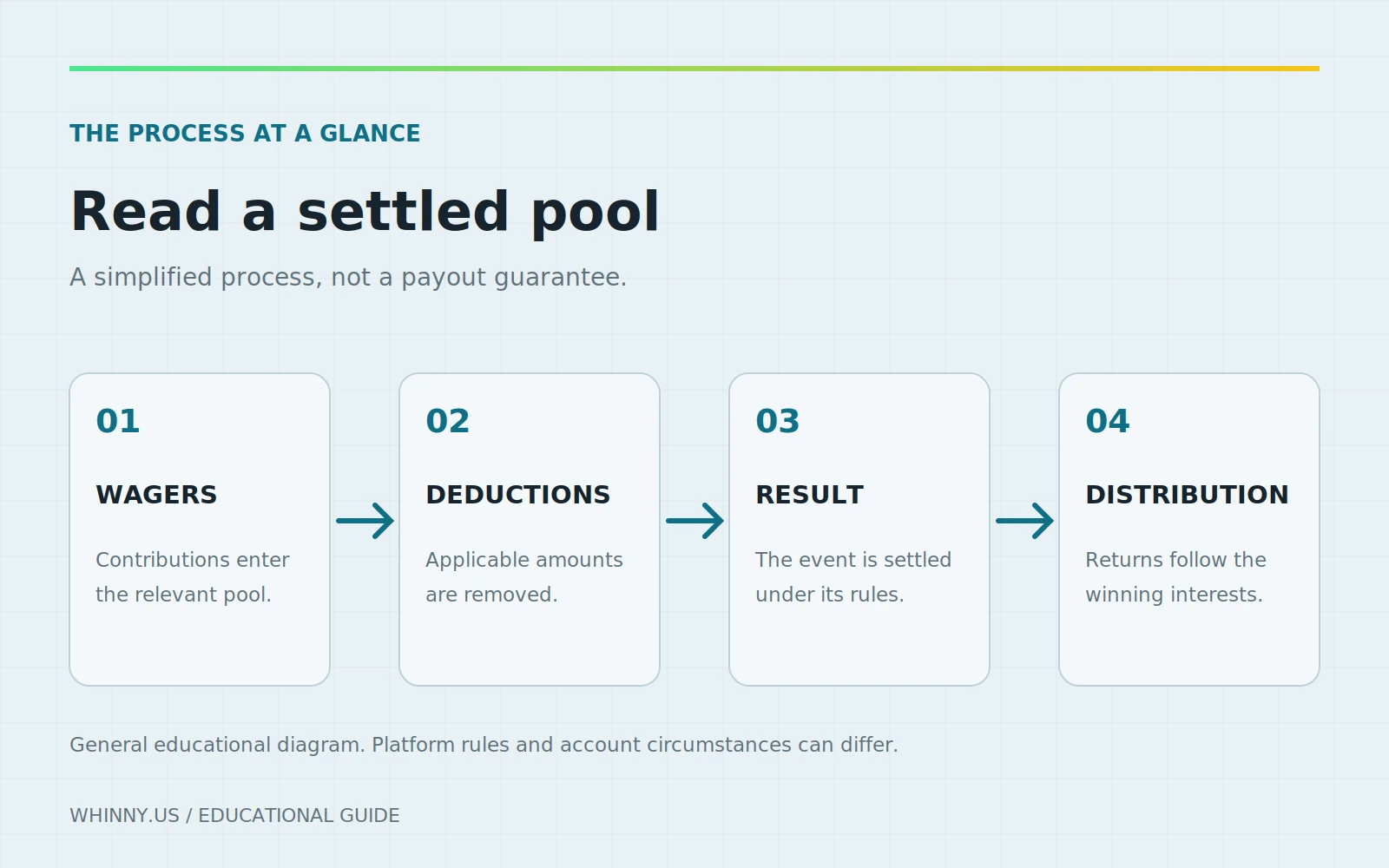
Start with the wager type, not just the event. NYRA’s explanation groups participants making the same type of wager in the same race; its toteboard odds reflect the Win pool specifically.[2] Consequently, a horse’s displayed Win odds do not provide a complete calculation for a different wager.
Gross pool, takeout, and distributable money
The gross pool is the starting collection of stakes in this simplified explanation. Takeout is the percentage removed from the pool; NYRA describes it as funding purses, expenses, and state taxes, and lists different rates for different wagers.[2] Do not assume one rate applies to every event or product.
For a simple single-winner illustration, the amount left after the assumed deduction is allocated in proportion to the winning stake. That is a distribution among winning units, not an equal payment to every winning person. Someone holding more eligible units has a larger share; the worked example below shows that relationship.
Keep three labels separate when reviewing a result: the total pool, the portion available for distribution, and the payout for one stated unit. A large pool total is not an individual prize.
3. A hypothetical settlement, calculated step by step
Illustration only: Every amount below is invented for arithmetic, not drawn from an actual event. The assumed 20% deduction is not a Whinny.us rate or a universal racing rate. The example assumes one winning interest, no refunds, no carryover, no special payout rules, and no rounding adjustment. It is not a forecast or a recommendation.
Assume a closed Win pool contains $10,000, and $2,000 of that total was staked on the eventual official winner. Applying the assumed deduction leaves $8,000 for distribution. Dividing by the winning stake gives a gross return of $4 for each winning $1.
| Calculation stage | Arithmetic | Result |
|---|---|---|
| Assumed deduction | $10,000 × 20% | $2,000 |
| Distributable pool | $10,000 − $2,000 | $8,000 |
| Gross return per winning dollar | $8,000 ÷ $2,000 | $4 |
| Gross return on a winning $2 stake | $2 × $4 | $8 |
| Profit on that winning stake | $8 − $2 | $6 |
| Gross return on a winning $5 stake | $5 × $4 | $20 |
Notice the difference between return and profit. In this example, an $8 return includes the original $2 winning stake; it is not $8 plus another $2. Likewise, the $5 winning stake produces $20 back and $15 profit. These are results for those winning stakes alone, not a calculation of someone’s overall gambling outcome.
The denominator matters as much as the pool total. Here it is the amount staked on the winner, not the number of account holders or the number of horses. Do not reuse this simplified formula for a multi-outcome distribution without checking that wager’s rules.
4. Read moving odds as a display, not a promise
NYRA distinguishes the morning line, which expresses the track handicapper’s expectation of post-time odds, from odds that change as money is wagered.[3] The morning line therefore should not be read as either an accepted fixed price or an official payout.
A changing display can also reflect processing timing. NYRA says wagering closes when the starting gate opens, while final odds appear after calculation of last-minute wagering from simulcast locations.[3] This is a specific explanation of NYRA’s process, not evidence about every operator’s systems.
If a displayed number changes after the event begins, record the display time and ask which pool update it represents. The visible movement alone does not establish when any particular wager was accepted. Distinguish the event’s wagering cutoff from the time your screen receives its final update.
5. Read a result in a consistent order
NYRA advises holding tickets until results are official because a disqualification can change the order of finish.[3] A replay or apparent finishing order is therefore not a substitute for the settlement record.
- Match the event. Check venue, date, race number, and any multi-race sequence against the receipt.
- Match the wager. Identify the pool and required outcome before interpreting the numbers.
- Find the official status. Separate a preliminary result from the declared result used for settlement.
- Read the payout denomination. Identify the stake unit to which the published amount applies rather than assuming it matches your ticket.
- Match winning units. Compare the eligible stake on the successful selection with that denomination.
- Check the transaction record. Distinguish a winning return from a refund or another settlement adjustment.
Treat this as a reconciliation checklist, not a way to select wagers. Its purpose is to identify what a published figure actually means and whether you are comparing like with like.
6. The same finishing order can produce different settlement questions
In NYRA’s standard definitions, Win requires first place, Place requires first or second, and Show requires first, second, or third.[2] An Exacta requires the first two horses in the correct order, while a Quinella permits either order.[2] The event result alone cannot tell you whether a ticket qualifies unless its wager type is also known.
Multi-race results need the whole sequence
NYRA defines a Daily Double using winners of two consecutive races and a Pick 3 using winners of three consecutive races.[2] Reading only the last race leaves part of the qualifying condition unchecked.
A displayed “will pay” also deserves its own label. NYRA warns that its multi-race will-pays do not reflect live money on scratched horses and describes circumstances in which the actual payout is lower.[2] Treat that as a concrete reason to distinguish a conditional display from the eventual official settlement, rather than assuming the displayed figure is guaranteed.
7. Check exceptions before explaining a difference
A scratch does not have one universal consequence. NYRA’s published examples distinguish refunds on certain single-race wagers from consolation treatment in specified Daily Double circumstances.[2] Those examples demonstrate why the rule for the exact wager matters; they are not instructions for settling another operator’s product.
Carryovers are similarly rule-dependent. NYRA describes a Pick 5 carryover when there are no tickets with all five winners, alongside a different distribution structure for the Pick 6.[3] The safe reading is that “no top-level winner” does not by itself tell you where the entire pool goes.
- Look for the published scratch, cancellation, and substitution provisions.
- Identify whether a displayed amount belongs to the current pool or includes an earlier carryover.
- Check any stated payout precision, minimum payment, or rounding provisions.
- Ask which rule explains the adjustment instead of inferring it from a headline amount.
8. Keep records, verify jurisdiction, and set boundaries
The Gambling Commission’s consumer-transparency guidance calls for information identifying the betting counterparty, responsibility for paying winnings, complaint routes, and settlement and deduction rules.[4] Although that guidance concerns Great Britain, these are useful questions for understanding any unfamiliar arrangement; it does not establish permission to participate elsewhere.
For a disputed figure, retain the receipt, event identifier, official result, displayed denomination, and relevant transaction entry. Ask support to identify the applicable settlement clause and calculation. Avoid sending passwords or unnecessary sensitive documents when requesting an explanation.
For related reading, visit Whinny.us’s legal-states FAQ, then verify the specific activity and location with the relevant regulator. This article does not establish that any particular product is legal where you are or available to you.
Responsible adult use: This material is educational, not betting, financial, or legal advice. Participation is only for adults who meet the applicable legal age and eligibility requirements. Gambling can cause financial and personal harm. Do not use essential funds or borrowed money, do not chase losses, and stop if participation becomes distressing. Choosing not to wager is always an option.
Frequently asked questions
Are the odds on my earlier screen locked in?
Not in the NYRA pool model described here: payouts depend on final odds at wagering close, not the odds visible when the wager was placed.[2]
Does a winning result show my profit?
Check the label. In the hypothetical example, gross return includes the winning stake. Subtracting that stake gives profit on that wager only.
Should I discard a ticket after watching the finish?
No. NYRA explicitly advises holding tickets until the result is official because disqualifications can change the order.[3]